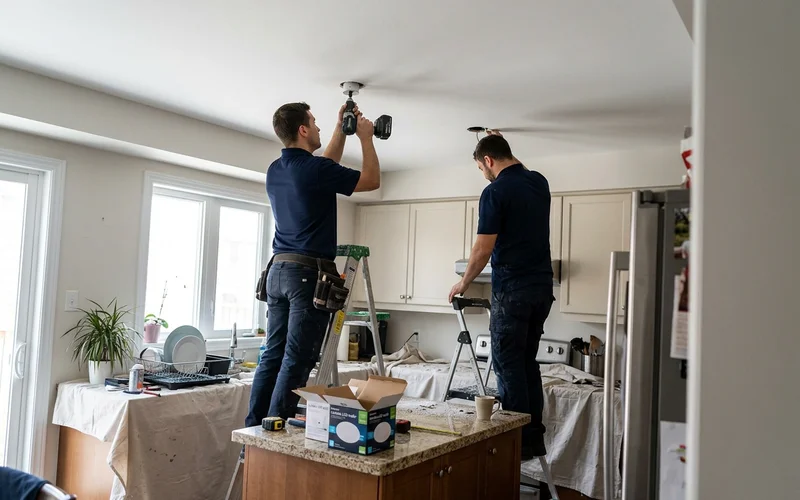
What Types of Kitchen Potlights Do We Install?
Not every kitchen ceiling takes the same fixture, and picking the wrong one is the fastest way to end up with glare or a dead corner. Here’s what we use most for potlight installation in Toronto and across the GTA.
Slim canless LED wafers
These are the go-to for flat drywall ceilings. A canless wafer is about half an inch thick, needs no housing in the ceiling and fits under joists, ductwork and even the shallow ceilings in a 1950s Etobicoke bungalow. They’re IC-rated and air-tight, so they can touch insulation under a top-floor attic without trouble. We buy them through Nedco and Robertson Electric in 2700K to 5000K with CRI 90+, which keeps food, wood and paint colours looking right.
Gimbal adjustable fixtures
Gimbals tilt up to about 35 degrees. On a cathedral or angled ceiling they let the beam hit the counter rather than the wall. They’re also handy for washing a feature backsplash or a run of open shelving.
5CCT selectable fixtures
A small switch on the driver lets us set the colour temperature on install day. They’re a good pick if you’re still torn between 3000K and 4000K.
How Much Does Kitchen Potlight Installation Cost in Toronto?
Our kitchen prices are all-in: fixtures, wiring, a new dimmer, patching and cleanup, so you won’t see add-ons later. Here’s what moves the number up or down.
| Cost factor | Lower end | Higher end |
|---|---|---|
| Fixture count | 4 to 6 lights, from $550 | 8+ lights with pendants, up to $1,200 |
| Ceiling type | Flat 8-foot drywall | Cathedral or 2-storey, from $750 |
| Access | Open attic above | Finished floor above, fished runs |
| Existing fixtures | None to remove | Old box light or halogen pots to patch |
| Extras | Single dimmer | Separate pendant and under-cabinet zones |
Cathedral ceilings take longer because wiring runs through rafters and we’re working off taller ladders. Century plaster in Rosedale or High Park also needs slower, dust-controlled cutting. We’ll price all of that on the written quote so nothing changes once the ceiling’s open.
When Is It Time to Redo Your Kitchen Lighting?
Most people call us for one of four reasons. The first is a single flush-mount light in the middle of the ceiling that throws your own shadow onto the cutting board. The second is old halogen pots that run hot, burn out every winter and don’t dim properly. The third is a renovation: new cabinets or an island went in, and the old light doesn’t line up with anything anymore. The fourth is resale. Agents in North York and Mississauga will tell you a bright kitchen photographs better, and potlights are one of the cheapest ways to get there.
Spring and early summer are our busiest kitchen months because that’s when renovations wrap up. If you’d like a specific date, book the consultation in late winter and we’ll hold a slot.
Common Kitchen Lighting Problems We Fix
Swiss cheese ceilings
A previous installer cut holes in the wrong spots, moved them and left the misses open. We patch every removed opening and redraw the layout properly.
Buzzing or flickering dimmers
Most of the time the dimmer isn’t rated for the LED driver. We match a Lutron Diva or Leviton dimmer to the fixture and set the low-end trim so there’s no flicker at 10 percent.
Shadows on the counter
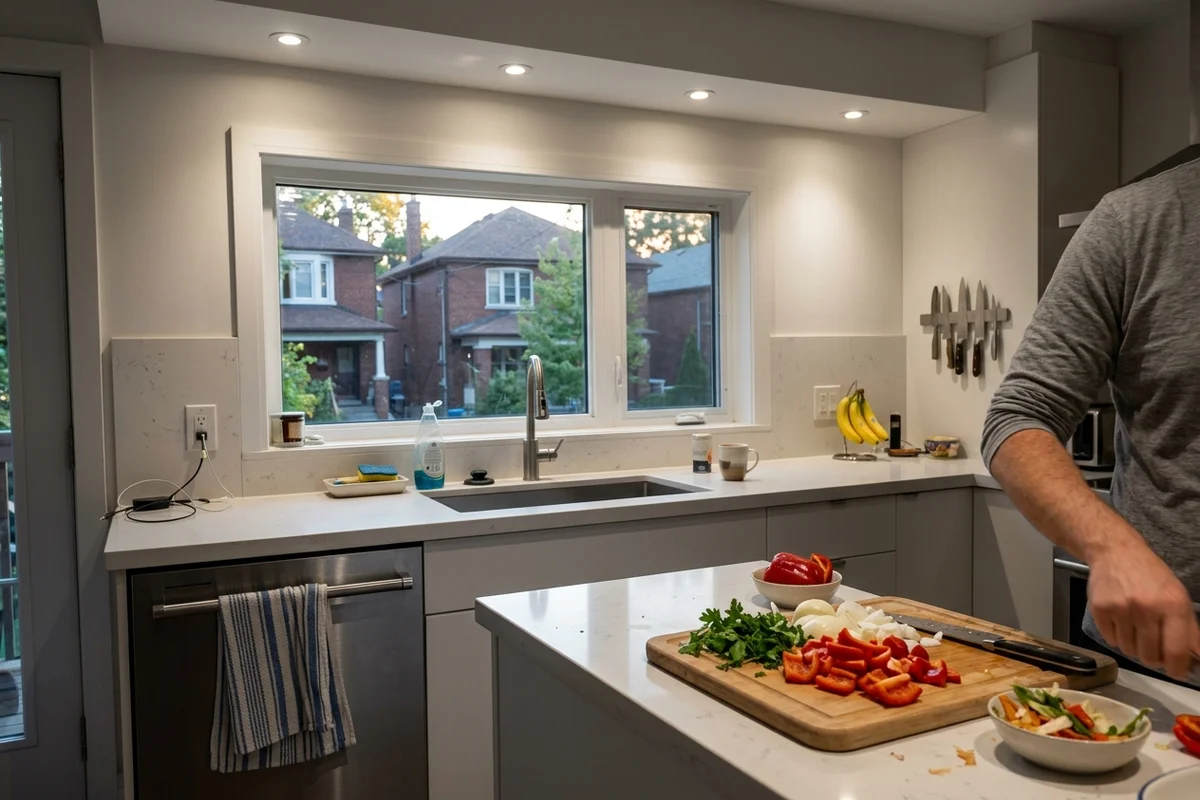
Lights placed in the middle of the room put the cook’s shadow right on the work surface. We pull the prep-zone potlights toward the cabinet face so the beam lands in front of you.
Too cold, too blue
Cheap 5000K fixtures make a kitchen feel like a clinic, especially on a grey November evening. We’ll swap to 3000K or 3500K and the room warms up straight away.
Kitchen Potlights vs. a Single Fixture or DIY
A single ceiling fixture can’t light an island, a sink and a corner pantry at once. Track lighting helps, but it collects grease and it’ll look dated fast. DIY potlight kits from the big box store are tempting, but they’re only as good as the layout, the dimmer match and the ESA notification. Without those, you risk flicker, uneven spacing and an insurance headache down the road. For a kitchen that you’ll use every day for the next 15 years, it’s worth getting a licensed electrician to plan and wire it once.
Want to see where your lights would go? Book a free in-home consultation and we’ll draw it up.